
Starting point
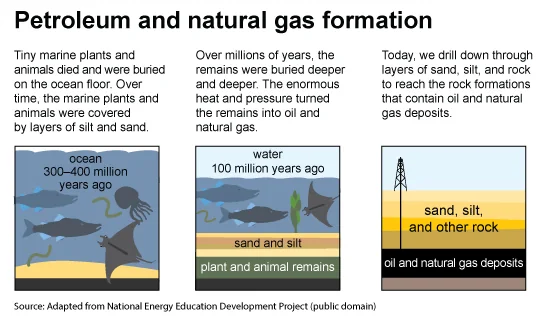
Petroleum does not begin as a ready-made underground liquid
Oil and gas are the outcome of a long chain of biological, sedimentary, chemical and thermal events. If organic matter is not preserved, buried, matured, expelled or given a migration route, petroleum generation or accumulation is interrupted. Organic-rich rock and a producible field are therefore not equivalent claims.
Petroleum did not come from dinosaurs
Much petroleum-prone organic matter came from microscopic aquatic life such as plankton and algae, with terrestrial plant material important in some settings. Large animal remains are not the controlling scientific explanation. Organic-matter type, depositional environment and preservation before complete decay are the critical starting conditions.
The formation chain: six stages that must remain distinct
This sequence is a teaching model. Actual rates, depths and temperatures depend on basin history and organic-matter type.
- 01
Biological production
Photosynthetic organisms and other organic material enter sediments in marine, lacustrine or deltaic environments.
- 02
Deposition and preservation
Rapid burial and oxygen-poor conditions may prevent part of the organic matter from being fully oxidised or decomposed.
- 03
Diagenesis and kerogen
During shallow burial, microbial and chemical processes convert organic material into more stable products, including kerogen.
- 04
Burial and thermal maturity
Additional sediment exposes source rock to a thermal history. Time and temperature together—not pressure alone—drive molecular transformation.
- 05
Generation and expulsion
At suitable maturity, kerogen generates oil and gas. The products must leave the very fine pore network of the source rock before wider movement can occur.
- 06
Migration and fate
Fluids move through permeable beds, fractures or carrier systems. They may leak, disperse or accumulate only if reservoir, seal and trap are available at the right time.
Time × temperature
Thermal maturity is not one universal depth or temperature
Two rocks at the same depth may have different maturity because burial rate, heat flow, exposure time and organic-matter type differ. Geochemists evaluate maturity using evidence such as vitrinite reflectance, Tmax and burial-history modelling. The slogan ‘deeper means more oil’ is therefore not a reliable technical rule.
Oil, gas and overmaturity
Product mix can change as maturity advances. Many oil-prone kerogens generate more liquid petroleum first and a larger gas fraction at higher maturity, but the boundaries are not universal. They depend on kerogen type and thermal history. Biogenic gas may also form through microbial activity at lower maturity and must be distinguished from the thermogenic route.
Concept boundary
Hydrocarbon generation ≠ an oil field
A source rock may generate petroleum without expelling it. Expelled petroleum may lack a viable pathway. Migrating fluid may arrive before a trap exists, breach a seal or disperse through poor reservoir rock. A field requires charge, reservoir, seal, trap, timing and preservation to work together—the subject of Lesson 03 on petroleum systems.
Bridge to well operations
Why does this matter to drilling and casing?
A well intersects rock units created by this history. Source, carrier, reservoir and seal intervals can present different pore pressures, mechanical behaviours and operational hazards. The well team must know which zones require isolation, where the pressure window may narrow and why casing design must follow the geological model and well data—not a generic diagram.
Glossary
Six terms for tracking the petroleum pathway
- Source rock
- Sedimentary rock containing enough suitable organic matter to generate and expel hydrocarbons if maturity is reached.
- Kerogen
- The solid, insoluble organic material in sedimentary rock that can generate oil and gas during thermal maturation.
- Thermal maturity
- The degree of heat-driven alteration of organic matter through burial history; not a single temperature or fixed depth.
- Generation
- Formation of oil or gas through thermal conversion of organic matter in a source rock.
- Expulsion
- The departure of generated petroleum from source rock into a carrier pathway.
- Migration
- Movement of petroleum away from the generation area toward a possible accumulation; migration alone does not guarantee a trap or field.
Learning check
Learning check
A mature source rock has generated oil. Can we conclude that an economic field exists above it? Explain your answer using the four links that follow generation.
Answer and reasoning
No. Petroleum must be expelled, migrate, enter suitable reservoir rock and become trapped beneath an effective seal. The trap must exist at the right time and the accumulation must be preserved. Reservoir quality, charge volume and economic producibility require separate evaluation.