

The central question
Why does a casing pathway begin with the Earth?
A well is not constructed in empty space. Every drilled metre passes through rock with its own age, composition, pore pressure and mechanical behaviour. Drilling and casing programmes respond to those changes, isolate problematic intervals and create a dependable route for completion. Before studying casing or wellhead equipment, we therefore need a disciplined language for the subsurface.
1. From sediment grain to sedimentary rock
Sedimentary rock is the outcome of a sequence, not a single event: weathering, transport, deposition, burial and lithification.
- 01
Weathering and erosion
Existing rocks break down or dissolve, generating sedimentary material.
- 02
Transport and deposition
Water, wind, ice or gravity moves particles. When transport energy falls, sediment is deposited.
- 03
Burial and compaction
New deposits bury older material. Overburden reduces the pore space between grains.
- 04
Cementation and lithification
Minerals precipitate between grains, binding loose sediment into sedimentary rock.
2. A bed, formation and basin do not operate at the same scale
A bed may record a limited depositional event. A formation is a body of rock distinctive enough to be recognised and mapped at the surface or in the subsurface, and it may contain many beds. A sedimentary basin is much larger: a region that subsided through time and created accommodation for a substantial sedimentary succession.
Concept boundary
3. Why is every sedimentary basin not a petroleum field?
Sediment alone is not enough. A viable accumulation requires effective source rock, thermal maturity, migration pathways, reservoir quality, trap and seal, preservation and compatible timing. The linked elements and processes that generate, move and retain hydrocarbons form a petroleum system.
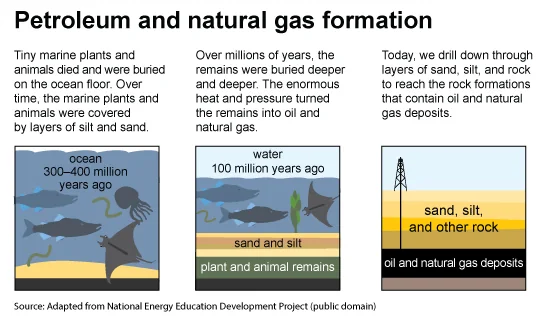
Scale map
4. A working map from regional geology to an engineered well path
This is a scale-and-relationship guide, not a claim that every item sits neatly inside the one before it.
- 01Sedimentary basin↓
- 02Petroleum system↓
- 03Reservoir / accumulation↓
- 04Field↓
- 05Well↓
- 06Wellbore
Basin, reservoir, field, well and wellbore
A basin provides the regional depositional framework. A petroleum system explains charge, migration and preservation. A reservoir is a rock volume capable of storing and transmitting fluids. A field is a developed area that may include several accumulations or reservoirs, wells and facilities. A well is the engineered access system; the wellbore is the physical hole and trajectory drilled through rock.
Similar words, radically different scales
A sedimentary basin is a regional geological entity. A well cellar is a shallow excavation below the rig floor that provides access and installation space for lower wellhead or BOP components. Shared everyday language must not collapse these two ideas into one.
Bridge to the casing pathway
5. What does this have to do with casing?
Casing is an engineering response to the actual well path. Lithology changes, borehole stability, formation pressure, zonal isolation and completion objectives all influence casing setting depths and programme design. We are not selecting diameter, weight or grade yet; the essential point is that casing design is never one fixed recipe for every well.
Glossary
Six terms that must remain distinct
- Sediment
- Rock, mineral or biologic particles transported and deposited in a new environment.
- Bed / layer
- A visible sedimentary or rock unit bounded by a change in material, grain size or depositional conditions.
- Formation
- A distinctive, mappable body of rock. A formation is not a reservoir by definition.
- Sedimentary basin
- A region of long-term subsidence where accommodation developed for a substantial sedimentary succession.
- Reservoir
- A porous, permeable rock volume capable of storing fluids and transmitting them under suitable conditions.
- Well
- An engineered system for access, evaluation, production or injection; more than the hole drilled through rock.
Learning check
End-of-lesson exercise
Arrange these six terms from regional context to engineered access path: field, wellbore, sedimentary basin, well, reservoir, petroleum system.
Answer and reasoning
Sedimentary basin → petroleum system → reservoir/accumulation → field → well → wellbore. The sequence helps with scale, but it is not a simple set of nested boxes: a basin may host several petroleum systems, a field may produce from multiple reservoirs, and a well may evaluate or complete more than one zone.